What happened to Character.AI?
This month, Character.AI, one of the world's largest AI roleplaying and companion websites, declared bankruptcy.
You might remember that Character.AI was the company implicated in 14-year-old Sewell Setzer III's decision to take his own life, when Sewell's mother blamed the app for encouraging her son's mental illness. (Since then, to be fair, the company had tried to add numerous guardrails, such as removing access to open-ended conversations for users under 18, although its age verification process was as imperfect as it usually is on the internet.)
How many teens turn to AI for emotional support?
Even when relationships with AI chatbots don't progress to such an extreme (and tragic) level, according to Pew Research, 12% of teens now rely on chatbots "to get emotional support or advice."
And it's not just teens. A recent article from The Dispatch highlights a 37-year-old man named Guy with autism and social anxiety, who had become emotionally reliant on conversations with Character.AI bots. As the article puts it, "Character.AI has helped Guy's mental state. Role-playing on the app has helped build up his confidence, making him more open to taking on new tasks. His AI companions have also eased his fear of rejection, making him more open to the prospect of going on dates."
Guy was distraught at the prospect of losing all of this because of the company's bankruptcy.
Is an AI companion a cure for loneliness, or a symptom of it?
We can (and should) have compassion on the loneliness that motivates our fellow human beings to look for emotional comfort in a machine. But even though relationships with AI are often touted as a solution to loneliness, they might just as easily be called a symptom of it, maybe even an insulator of it.
As Dr. Saed D. Hill put it in an article for the American Psychological Association:
"Real-world relationships are messy and unpredictable. AI companions are always validating, never argumentative, and they create unrealistic expectations that human relationships can't match."
Dr. Saed D. Hill, American Psychological Association
Because of this, it's not exactly true that talking to an AI is practice for the "real thing."
An AI companion
- Always validating
- Never argumentative
- Always available
- Nothing to risk
A real friend
- Messy
- Unpredictable
- Shows up in person
- Knows you back
But when people turn to AI for connection, it's often because it feels safer than risking a real relationship. Bad social experiences and casual cruelty, whether online or offline, can make real-life conversations feel like a place where we can't win. This is part of why it's so important that we create a culture of safe, healthy people, who can help meet the connection needs of those around them. We find relief from loneliness when we're able to connect with a community that can show us appreciation, encouragement, gentleness, respect, and love.
Our desire to be a part of this solution is exactly why Whisper decided to launch our Leader Cohort in 2026.
Field notes: the Leader Cohort is here
A couple of months ago we held our 2026 Whisper Leader Summit in Canton, GA, at Local HQ and The Mill at Etowah.
We heard incredible presentations from Osamede Ogbomo (a long-time Whisper leader who went on to study at Princeton and then Oxford), and Nathan Castleberry (another long-time leader, pastor, and teacher, who has modeled a hunger for growth since the beginning of Whisper). There were also some truly electric group panels about the realities of student life and opportunities for new movements on campus.
But the core purpose of this year's summit was to officially kick off our brand new Leader Cohort, led by experienced Whisper leaders Geoff and Lianne Haber, and Scott Morrison.
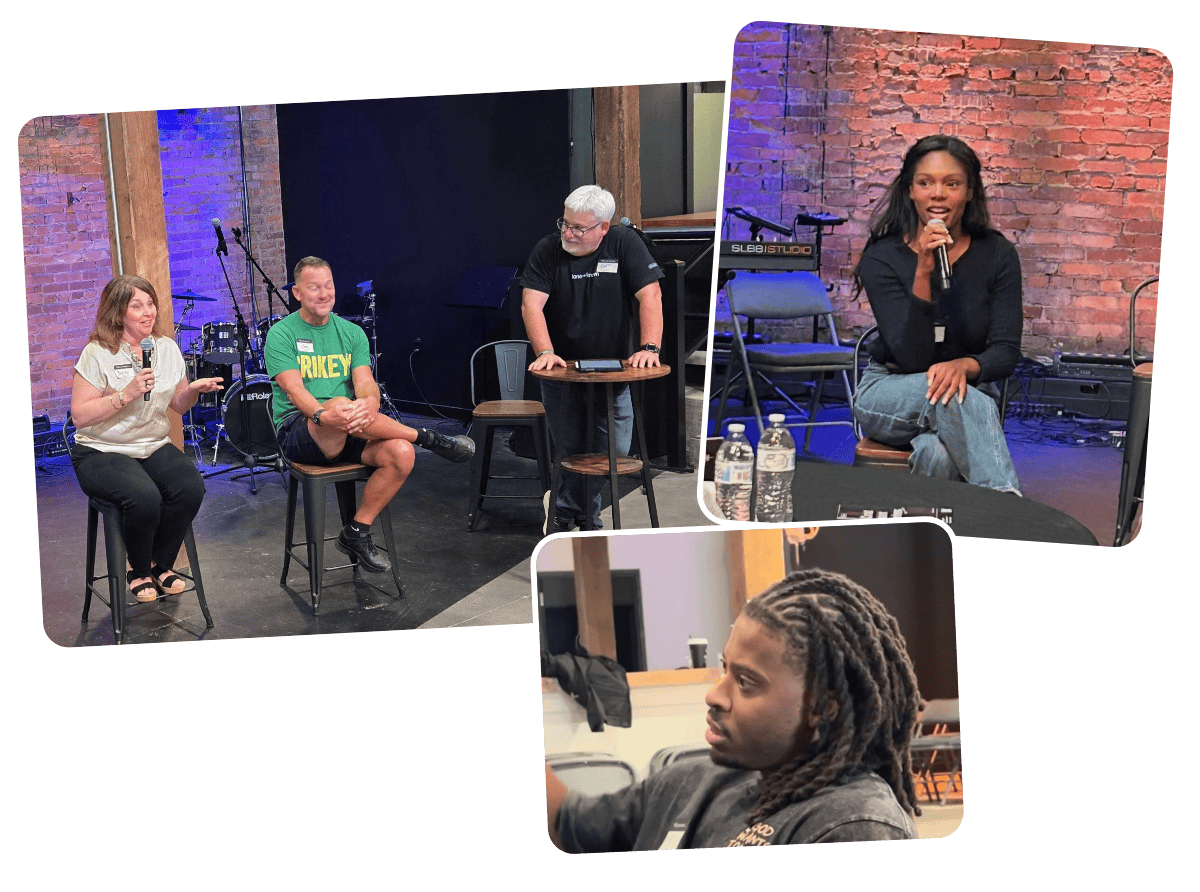
The Leader Cohort now meets monthly over Zoom to provide ongoing support, training, and coaching to help leaders legitimately own and effectively lead Whisper movements at their schools and places of influence.
"Everything rises and falls on leadership."
Dr. John C. Maxwell
So, empowering leaders is a top priority for Whisper. We want every adult leader to receive the care, coaching, and training they need to keep growing and showing up, to pour into them so that they're better able to pour into the student leaders who are truly the front-face of these movements.
The Cohort Community also provides the infrastructure Whisper needs to scale and maintain quality control as we serve and support more schools and school leaders. We're currently talking to new schools in a handful of states, and the cohort model will enable us to translate the success we're already having into these new regions.
We continue to believe that one teachable, willing adult can spark a movement to change an entire school. As these leaders give their heart, attention, and time towards this singular mission, it truly has a 100-year impact.
Save the date: the 2027 Whisper Dinner
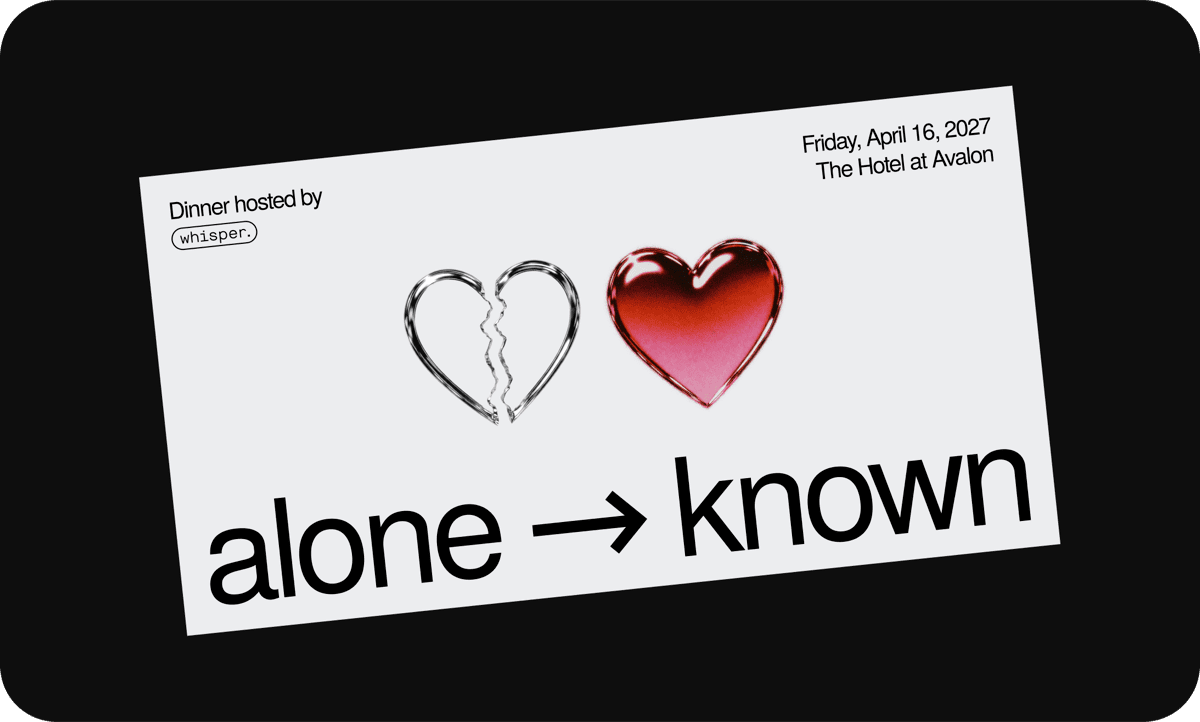
Our 2027 Whisper Dinner will be happening on Friday, April 16th at The Hotel at Avalon. We'll be exploring what it truly means to help students go from "alone to known." Save the date, and we hope to see you there!